


noticia-news-XIIMedConf
All delegates stood up as Raimondo Fattori, President of the Red Cross of the Republic of San Marino, asked for a minute of silence "to remember all our friends who have left us in the past few years; and especially, one minute of silence to commemorate, to feel close to us, all Red Cross volunteers and, above all, Red Crescent volunteers who have lost their lives sacrificing themselves for others, rushing into the battlefield." 1

The Red Cross of the Republic of San Marino hosted the 12th Mediterranean Conference of the Red Cross and Red Crescent Societies between the 25th and 28th May 2015. For the first time, all 26 Mediterranean National Societies belonging to the Conference participated in the meeting, in a time "in which Mediterranean National Societies are increasingly faced with humanitarian challenges such as migration, conflicts, violence, environmental hazards and the social effects of the economic crisis"2 which require a broader, coordinated action.
Mr. Tataderu Konoé, President of the International Federation of the Red Cross and Red Crescent Societies (IFRC), specified during Opening Ceremony that "the Mediterranean region faces a growing set of humanitarian challenges. These challenges are rooted in the chronic poverty of countries that neighbour this region, in political and economic failures, in the growing numbers of natural disasters, and most prominently, in protracted conflicts that are at once influenced by, and influencers of, these other factors". The President reminded that "the National Societies here are connected by more than the Mediterranean Sea. You are connected by a common humanitarian environment, and an understanding, reinforced by experience, that what affects one country will almost always affect others in some way."
Opening Ceremony table of the 12th Mediterranean Conference
Participants asserted their commitment "to increase their response to the growing humanitarian issues in the Mediterranean region". The San Marino Declaration is the outcome of three intense working days, debates and discussions in plenary sessions and workshops about: Fundamental Principles and Humanitarian Diplomacy, Crisis response and preparedness, Youth and Volunteering promotion, Assistance and protection to migrants, and Social inclusion and the promotion of a culture of non-violence and peace. Four specific workshops were also developed: climate change and environment, social effects of the economic crisis, migration and youth, and human trafficking.
'Fundamental Principles' and 'Youth and Volunteering promotion'
Participants underlined that the Fundamental Principles remain relevant to the Movement's actions. They are the best framework for the decision making of Red Cross and Red Crescent National Societies (NS) as they give credibility to NS's actions. The Fundamental Principles are embedded in the daily humanitarian operations; therefore, staff and volunteers are the main actors in humanitarian diplomacy when they deliver the Movement's services to the people in need.
The session on 'Youth and Volunteering Promotion' was also particularly relevant as Youth representatives presented the Statement of the 1st RC/RC Mediterranean Youth Meeting, and committed themselves "to become the role models to live the Fundamental Principles and the resource to address the root causes of violence." It was highlighted that National Societies must pay more attention to volunteers' needs as they ought to be better prepared to tackle new humanitarian challenges related to migration, health and the promotion of a culture of non-violence and peace. It was reminded that all National Societies should adopt the Youth Engagement Strategy (Y.E.S.), as underlined during the 2013 General Assembly; although until now only 10 Mediterranean National Societies out of 26 has done so.
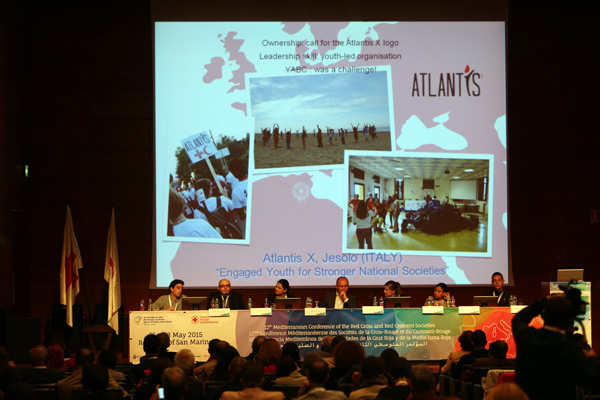
Youth representatives reporting on the Atlantis Youth Camp
In the session about 'Social Inclusion and the promotion of a Culture of Non-Violence and Peace', underlining the Principle of Humanity which also promotes "cooperation and lasting peace amongst all peoples", the need to change to positive behaviours in order to influence the causes of violence was also stressed. The Youth as Agents of Behavioural Change toolkit (YABC) provides a set of skills that support personal change, aiding users to become leaders in their communities in the change of attitudes and behaviours towards more inclusive societies. During the Conference, it was suggested that the programme be wider and become ABC (Agents of Behavioural Change), including all volunteers and staff, not only Youth.
Crisis response and preparedness
Syrian, Libyan and Lebanese delegates shared their National Societies activities and planning during the session on 'Crisis response and preparedness'. Syria is currently in its 5th year of conflict with half of its population displaced, either internally or externally. The destruction of cities has left the population without access to basic structures such as water resources or sanitation. The Syrian Arab Red Crescent (SARC) keeps acting in emergency situations and it has widened its field of action towards the infrastructures destroyed during the conflicts.
Lebanon is one of the countries with the highest number of Syrian refugees, hosting more than 1 million people and only second to Turkey, with over 1 million 7 hundred thousand refugees (UNHCR). National Societies have coped with the sudden arrival of thousands of people and they have started to plan emergency actions to be better prepared in the future. The situation in Libya has deteriorated with an increase of violence and, moreover, it is one of the first departure points of migrants towards Europe, with a huge number of smugglers acting in its territory.
The challenges are huge. In five years of conflict in Syria we mourn the loss of 50 Red Cross and Red Crescent volunteers, 42 from SARC and 8 from the Palestine Red Crescent Society. Senior and Youth delegates participating in the Conference remembered them, and recommended to improve the security and safety for the Movement members working to reach and support vulnerable people and victims in the conflict. The Mediterranean National Societies remarked how the respect of International Humanitarian Law (IHL), medical structures and personnel has become a challenge, and recommend that particular efforts be made in crisis preparedness, contingency planning and development, by involving relevant stakeholders in times of conflict and in times of peace.
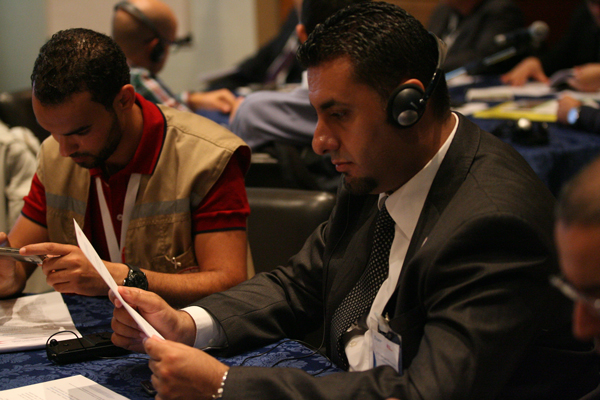
Participants during the workshop 'Climate Change and Environment'
Two specific workshops were carried out to delve into different types of crisis. One of them was on the social effects of the economic crisis. Single parents, women, elderly, youth and migrants are the most vulnerable people during an economic crisis. National Societies remarked the need to combine the immediate support of basic needs with a long term social empowerment to build community resilience.
'Climate change and environment' was the second workshop related to the 'Crisis response and preparedness' session. With an increase of climate related phenomena like floods or droughts, National Societies in the Mediterranean Conference stated that community resilience has to improve, and NS should increase awareness on the subject, promote changes of habits, exchange data, and strengthen early warning systems.
Assistance and Protection to Migrants
The San Marino Declaration stated that migrants must be able to move safely and must be treated with dignity and respect without consideration of nationality, administrative or legal status. National Societies need to think trans-regionally, to harmonize the approaches and to coordinate their humanitarian actions. As stated by IFRC President, Tadateru Konoé, "the issue of migration is inseparable from the unresolved conflicts and unaddressed poverty that drives it", therefore it is mandatory to tackle the root causes of migration.
National Societies keep providing emergency primary support, health facilities, Restoring Family Links (RFL) and psychosocial support (PSS), yet it was also recommended that they work on their institutional capacities to promote social inclusion of migrants in their communities.
Aside from the main session about 'Assistance and protection to migrants', there were two specific workshops regarding, on one hand, the relevance of young volunteers and young migrants in migration strategies; and on the other, how to tackle the challenges posed by human trafficking.
The workshop on 'Migration and Youth' focused on the inclusion of Youth volunteers and migrants in the strategic planning, involving (young) migrants as active partners. It was agreed to look for the promotion of partnerships with other NGO's, universities, private and public institutions and to focus on non-formal education like YABC (Youth as Agents of Behavioural Change).
Human Trafficking was also discussed in a dedicated workshop whose conclusions remarked that National Societies should increase the efforts to recognize the victims of trafficking and give them access to information and support regardless their legal situation. The need to increase awareness and education of the general public on this topic was also stressed.
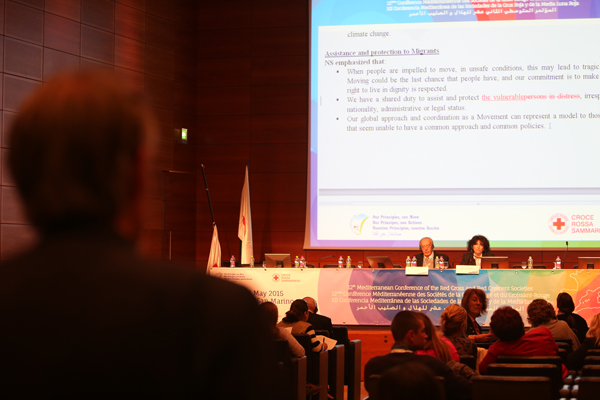
Adoption of the Final Document and Closing of the Conference
150 delegates gathered for the 12th Mediterranean Conference in the year that marks the 50th anniversary of the Declaration of the Fundamental Principles. The main personalities of the Republic of San Marino were present either on the Opening ceremony, either at the Closing session. Both Captains Regents, Mr. Andrea Belluzzi and Mr. Roberto Venturini, attended the reading of the San Marino Declaration on May 28th, while the Secretary of State for Health, Francesco Mussoni, the Secretary of State for Foreign Affairs, Pasquale Valentini, and the Secretary of State of Interior, Gian Carlo Venturini, participated in the Opening Ceremony.
The Mediterranean Conference of the Red Cross and Red Crescent Societies convenes the National Societies of the Mediterranean and other National Societies who have historical or geographical links with the region, thus creating a link between countries of Europe, the Middle East and North Africa.
_____________
1 "[...] vi chiedo soltanto un minuto di pazienza , un minuto in piedi, un minuto en silenzio per ricordare tutti gli amici cue ci hanno lasciato nel corso di questi anni. E sopratutto un minuto di silenzio per commemorare, per sentire vicina noi tutti i volontari di Croce Rossa ma sopratutto di Mezzaluna Rossa che nell'arco di questi anni hanno lasciato la loro vita, sacrificandosi per il bene altrui, correndo nei campi di battaglia, gestendo ospedali. Voi sapete tutti di quello di cui sto parlando. Grazie" Opening ceremony, May 26, 2015.
2 San Marino Declaration